Journal Identification
ISSN: 3059-8303
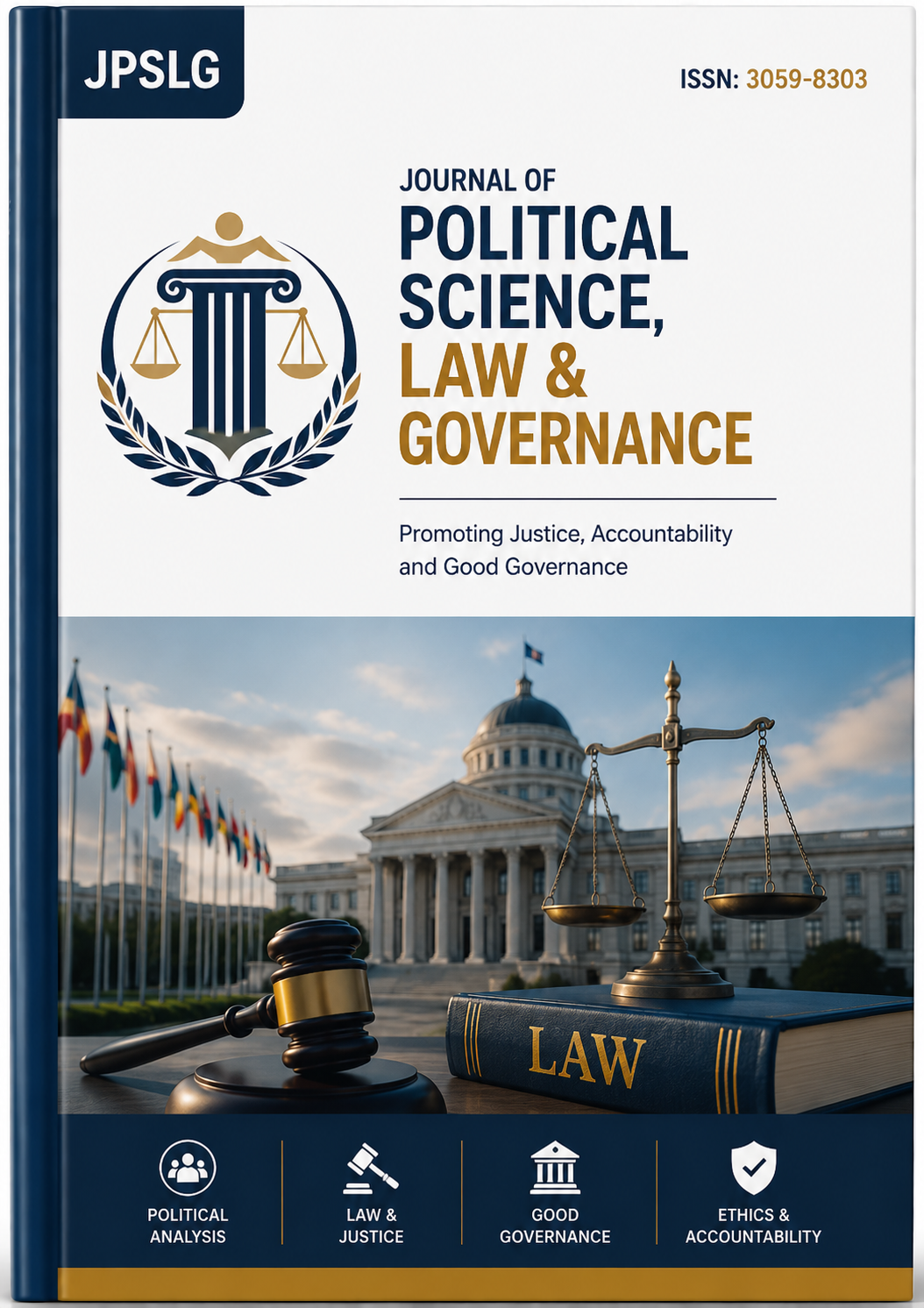
The ISSN has been officially assigned to the Journal of Political Science, Law & Governance.
The Journal of Political Science, Law & Governance is dedicated to publishing high-quality, original, and peer-reviewed scholarly research across political science, law, governance, public policy, international relations, public administration, constitutional studies, human rights, and related interdisciplinary fields. The journal aims to promote academic integrity, critical inquiry, evidence-based policymaking, democratic values, and global scholarly exchange.
The journal provides a platform for researchers, academicians, policymakers, legal professionals, public administrators, and scholars to publish significant theoretical, empirical, and applied research that contributes to the advancement of political, legal, and governance knowledge and practice. The journal encourages interdisciplinary approaches that address contemporary challenges in public administration, law, policy formulation, institutional development, governance systems, democracy, and social justice.
All submissions undergo a rigorous double-blind peer review process to ensure academic quality, originality, and research integrity.
The journal follows internationally recognized publishing ethics standards and adheres to the principles and best practices recommended by the Committee on Publication Ethics (COPE).
Editorial decisions are made independently based on academic quality, originality, relevance, and peer-review recommendations. Publication fees, sponsorships, political interests, or commercial considerations do not influence editorial decisions.
Manuscripts containing plagiarism, duplicate publication, manipulated data, authorship misconduct, citation manipulation, or unethical research practices may be rejected or retracted. The journal follows recognized ethical guidelines for corrections, expressions of concern, and retractions where necessary.
The journal provides immediate open access to published content to support the global exchange of scholarly knowledge. Authors retain copyright of their work and articles are published under the Creative Commons Attribution License (CC BY 4.0), unless otherwise stated.
The journal ensures long-term digital preservation and accessibility of published content through recognized preservation systems, including the PKP Preservation Network (PKP PN). Published articles remain permanently accessible for scholarly reference, citation, and future research.
Authors must disclose the use of artificial intelligence (AI) tools or generative technologies used in manuscript preparation. AI tools cannot be listed as authors, and authors remain fully responsible for the accuracy, originality, validity, and integrity of submitted work.
The ISSN has been officially assigned to the Journal of Political Science, Law & Governance.
For publication in Scopus, Web of Science, and more – Expert consultation for indexed journal submissions.


 Licensing: Creative Commons Attribution 4.0 International License (CC BY 4.0)
© Tresearch OÜ | Registry Code: 17171326
Harju maakond, Tallinn, Kesklinna linnaosa, Ahtri tn 12, 15551, Estonia
Email: [email protected]